Monday, 25 June 2012

Rugby anyone?

My first visit to Rugby revealed in all it's glory, St Marie's Catholic Parish Church. This fine example of Pugin's Gothic Revival style stands proud on the Dunchurch Road in the midst of a large churchyard and looks every bit like an ancient CofE parish church until you get close. This must've been what it was like in England before the reformation.

The really good news is that latter day liturgical re-orderings have done very little to spoil Pugin's interior with its God-ward orientation. Only the temporary altar and the misplaced font stand out as being slightly at odds with overall style.

Pray for the soul of Cpt John Hubert Washington Hibbert, founding benefactor of the Church and the Rosminians who care for it and have done so since 1849.

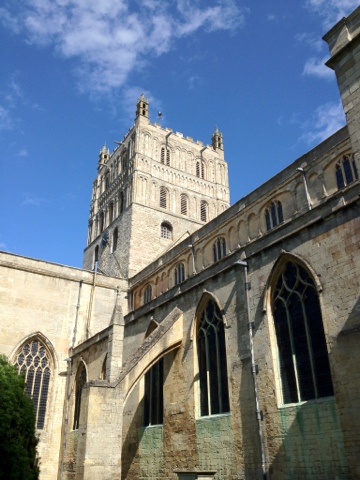
Tewkesbury Abbey

Yesterday I had the great joy of fulfilling the SSIM duties in glorious Tewkesbury Abbey. Built by the Benedictines it was consecrated in 1121. Our Anglican brothers and sisters obviously care greatly for the buildings which exude an atmosphere of prayer. I was reminded of a line from an Anglican hymn: "These stones that have echoed their praises are holy..."

Saturday, 23 June 2012

From Aristotle to Dorothy

The English countryside is dotted with churches which had been places of Catholic worship until the horrors of the 16th century. One such is the the (now Anglican) Church of St Margaret of Antioch in the small village of Hemingford Abbots in Cambridgeshire.

The first recorded Rector, in 1200, was one Aristotle a monk of Ramsey Abbey, the current incumbent is Dorothy! I prayed for them both during a visit there today as well as all who have worshipped there down the centuries and of course the current congregation. "That they may be one".

The Font has been in continual use since 1200 to impart God's grace in the Sacrament of Baptism.

Wednesday, 20 June 2012

St Alban, Proto-martyr of Britain

Friday this week is the Feast of St Alban.  What better can I do than share with you our friend, Fr Alexander Lucie-Smith's article on the Catholic Herald blog on this great saint.
http://www.catholicherald.co.uk/commentandblogs/2012/06/20/how-a-pagan-soldier-was-moved-by-the-faith-of-a-christian-priest/#.T-Hka3Fpolk.facebook


Monday, 18 June 2012

Whalley Abbey

I had the opportunity to visit the ruins of Whalley Abbey in Lancashire today as well as it's neighbouring 13th century Church of St Mary and All Saints.

The choir stalls in the church were originally made for the Abbey around 1430 and moved to the Church at the Dissolution.

The Abbey itself was a Cistercian house, having moved from Stanlow in Cheshire in 1296. The Abbey Church was completed in 1380 although the Abbot's lodging wasn't finished until 1440.

The monks sang the office in stalls over a Choir pit, which is still very clearly visible today. It is believed these covered ditches added resonance to the chant.

In 1537 the buildings passed into private ownership and a Manor House was built of the sacred stones. So it remained until it became the property of the Anglican Church in 1923. It is now the Diocese of Bradford's retreat house and they have built a new stone altar on the site of the ancient High Altar, in the midst of the ruins.

Friday, 15 June 2012

O Sacred Heart!

St Claude de la Colombiere and the Sacred Heart
Today is the Feast of the Most Sacred Heart of Jesus, celebrated in the Universal Church, 19 days after Pentecost, since 1856 although devotion to Our Lord's Heart goes back much further than that.  The Feast speaks to us of the boundless love, compassion and long-suffering of Christ's heart towards God's people.

In its present form, the devotion dates to the visions of St Marguerite Marie Alacoque, which took place between 1673-75 in the convent of the Visitation sisters in Paray-le-Monial in the centre of France.  The great apparition took place during the Octave of Corpus Christi in 1675 when our Lord said to Sr Margaret-Mary, "Behold the Heart that has so loved men... instead of gratitude I receive from the greater part only ingratitude"  He asked her for a Feast to be instituted on this day and told her to consult her confessor about it.

That Confessor was Claude de la Colombiere, a Jesuit.  Having had the vision reported to him he became one of the first to consecrate himself to the Sacred Heart and the task of spreading the devotion fell to the Visitation Sisters and to the Jesuits.

Margaret-Mary was herself canonised by Pope Benedict XV on 13 May 1902 and Fr Claude, her confessor, by Pope John Paul II on 31 May 1992.


Ss Margaret Mary and her Confessor, St Claude de la Colombiere

In 1676, Claude was sent to Great Britain to be Chaplain to the Duchess of York (Mary of Modena) and lived the life of a religious in St James's Palace - he continued as an active missionary in these lands as he had been in France and was a zealous apostle of the devotion to the Sacred Heart.

St Claude - Pray for us!
St Margaret Mary - pray for us!
Most Sacred Heart of Jesus - Make our hearts like unto Thine Heart!
Relic of St Claude

Thursday, 14 June 2012

Salisbury Cathedral

A member from Plymouth has been in touch to tell us that she recently visited the Cathedral of the Blessed Virgin Mary in Salisbury to recite the SSIM prayers.


The Cathedral and See moved from Old Sarum to Salisbury in the early 13thC under Bishop Richard Poore.  The Cathedral was built between the years 1220 and 1258 in the Early English Gothic Style.


The Cathedral houses the tomb of St Osmund of Salisbury, who was Bishop of Old Sarum from 1078-99.  He was an Norman nobleman with the title Count of Sees and was also for a time Lord Chancellor (1070-78).  Osmund was noted for building the Cathedral at Old Sarum, establishing a Cathedral governing body based on the Norman system, comprising a dean, precentor, chancellor, treasurer, 32 canons, a sub-dean and subcenter and thirdly for the formation of the 'Sarum Use' in the liturgy.


William of Malmesbury said of Osmund: "so eminent for chastity that common fame would itself blush to speak otherwise than truthfully concerning his virtue. Stern he might appear to penitents, but not more severe to them than to himself. Free from ambition, he neither imprudently wasted his own substance, nor sought the wealth of others".  He was canonised on 1 January 1457.


In 1472 Pope Sixtus IV granted an indugence to those who visit his Cathedral on his festival (4 December)